“YOU ARE LYING TO ME!”
I said it out loud to an object with no ears, no feelings, and absolutely no reason to care: ChatGPT.
Every AI news channel I followed kept talking about how smart it was. So I gave it a real assignment: create a digital marketing plan. One condition mattered to me. I wanted something unique, not the advice I could find anywhere.
The answer was the safest, most cover-your-butt marketing plan I’d seen in years. Familiar recommendations. Nothing that made me think differently. And ChatGPT presented it as something unique.
I’d seen people try to pass off that kind of plan as strategy. What bothered me even more was how easily I could have accepted it, passed it along, and surrendered my own critical thinking.
So I yelled at the machine again. Then I stopped arguing with something that couldn’t hear me and typed four words:
“What did you miss?”
Lo and behold, the answer changed. ChatGPT began listing what the first plan had overlooked. It even told me I was right to push back. I stared at the screen. If it could find the holes once I asked, why didn’t it bring them up in the first place?
I never got mad at ChatGPT again. I’d learned what I was dealing with: a confident first-response liar. Not a machine plotting to deceive me. A machine that could make an ordinary, incomplete answer sound ready to trust.
I shut my laptop, left my standing desk, and sat on the couch. Then I opened YouTube and searched for a better way to prompt ChatGPT. If four words could change the answer, what else was I missing?
That’s when I found Sabrina Ramonov.
Her short YouTube video taught three simple ChatGPT prompts. I had gone looking for better words to type into a box. What interested me was that the prompts gave me three ways to think differently about the answer.
About two years of trial and error using AI for business taught me something those three lines alone could not. You can skip a lot of those wrong turns. I’ll show you what I kept, what I changed, and why I now take a second pass before accepting AI-assisted work that matters.
Three prompts. Three different jobs.
Sabrina’s May 2025 video was short, and the pitch was irresistible: add a line to your ChatGPT prompt and get an answer that’s “10x better.” Who wouldn’t want that? After the marketing plan I’d just seen, I was ready to try something that might make the machine earn its confidence.
But the number was Sabrina’s description, not a measured improvement I could claim for my work. What mattered to me was that each of her three ChatGPT prompts attacked a different problem.
The first: “Ask me clarifying questions until you are 95% confident you can complete the task.” In plain English: stop guessing what I want and ask what you need to know.
The second: “What would a top 0.1% expert in this field think?” Raise the standard. Sabrina credited Ethan Mollick for the expert-perspective idea, and that credit matters.
The third: “Reframe this in a way that challenges how I view the problem.” Don’t take my question at face value. Ask whether I’m looking at the right problem.
I tried the ideas during real business work. I didn’t run a controlled experiment on these exact lines, and I didn’t keep a record of every time I used them. My verdict comes from what I could observe and defend, including where my own first reaction was wrong.
The first prompt almost created more work
I wanted ChatGPT to ask better questions. The trouble came when it kept asking questions the project had already answered.
In Sabrina’s example, clarifying questions made an AI academy idea more concrete: Who would it serve? What would it offer? How would it work? Those are exactly the questions to ask when someone brings you an unfinished idea.
Using ChatGPT prompts for business doesn’t always mean starting from a blank page. I often already had the target audience, approved message, source documents, and a specific deliverable. Having AI interview me about all of that again wasn’t a breakthrough. It was another meeting with no agenda.
That also sent me back to my first marketing-plan complaint. I’d asked for something “unique.” Unique compared with what? A prompt can ask for an ambitious result while leaving the test for success undefined. The AI still has responsibility to avoid unsupported claims, but I can give it a better assignment.
So my instructions became more concrete: Task. Context. Source. Requirements. Constraints. Ask only the questions that would change the work. When the governing information is already available, use it.
The lesson wasn’t that Sabrina’s first prompt failed. It was that the useful question depends on how much the AI already knows. For business work, clarity is cheaper than another round of guessing.
The expert prompt I nearly dismissed
I was ready to throw out Sabrina’s second prompt. “Top 0.1% expert” sounded like a request for the machine to put on an expensive suit and speak with authority.
Then I went back to her example. Instead of applauding a business idea, the AI raised investor-style questions: How big is the market? What do the margins look like? How will customers find it? Can competitors copy it?
Those were better questions. My criticism had been too broad.
I kept the perspective change and added a standard the answer would have to meet. For marketing decisions, that could mean the intended buyer, approved positioning, original sources, and what counts as evidence. Asking for an expert’s perspective can make the AI consider another angle. It does not put an actual expert in the room.
I thought I’d learned to challenge the answer. The next question was harder: what happens when the AI agrees with the person challenging it?
The dangerous part: it agreed with me
Remember the marketing plan? The first answer had confidently sold me a generic strategy. The second answer, after “What did you miss?”, told me I was right and produced a list of omissions.
Better. But think about that for a second. The same system that had sounded certain the first time now sounded certain that I was correct to disagree. Agreement is pleasant. It isn’t verification.
I’d started using “What did you miss?” before finding Sabrina’s video. Her third idea sharpened the habit: challenge the frame of the problem, not just the missing items in an answer. Sometimes you’re trying to improve an answer to a question you shouldn’t have asked in the first place.
There is research supporting a narrower reason for caution. In a July 2026 study, Zheyuan Liu and colleagues tested 12 AI models on 968 annotated tool-use dialogues. The models struggled more with mistakes made by the assistant than with errors originating from users, and checking their own earlier work was harder than critiquing another conversation. That was a benchmark of tool-use errors, not a measured failure rate for marketing copy.
It didn’t prove my approach works. It did reinforce a distinction I could no longer ignore: asking AI to criticize itself is useful, but a convincing critique still needs something outside the original answer to check against.
The day SHIP turned into HOLD
I eventually gave that distinction a name: the Second-Pass Audit. Its job is simple. Return to the source. Compare what was requested with what was produced. Find material differences, correct what the evidence supports, check the changes, and make a decision: SHIP, REVISE, or HOLD.
One of my clearest examples came from work on the public materials for the Second-Pass Audit itself. We had an article, distribution copy, an email, metadata, and links. The package appeared close to ready. I could have approved it because it looked finished.
The source-grounded review found outdated positioning, a wrong call to action, incorrect public decision labels, an outdated URL, and a proof claim stronger than the record supported. Any one of those problems was worth fixing before the material went public. Together they changed the decision.
SHIP became HOLD until the issues were corrected.
That’s the part of AI decision making I care about. The audit didn’t win an argument with a chatbot. It changed what I was willing to approve. A business owner doesn’t need to admire a clever prompt. They need to know whether the proposal, campaign, customer email, or decision in front of them is ready to use.
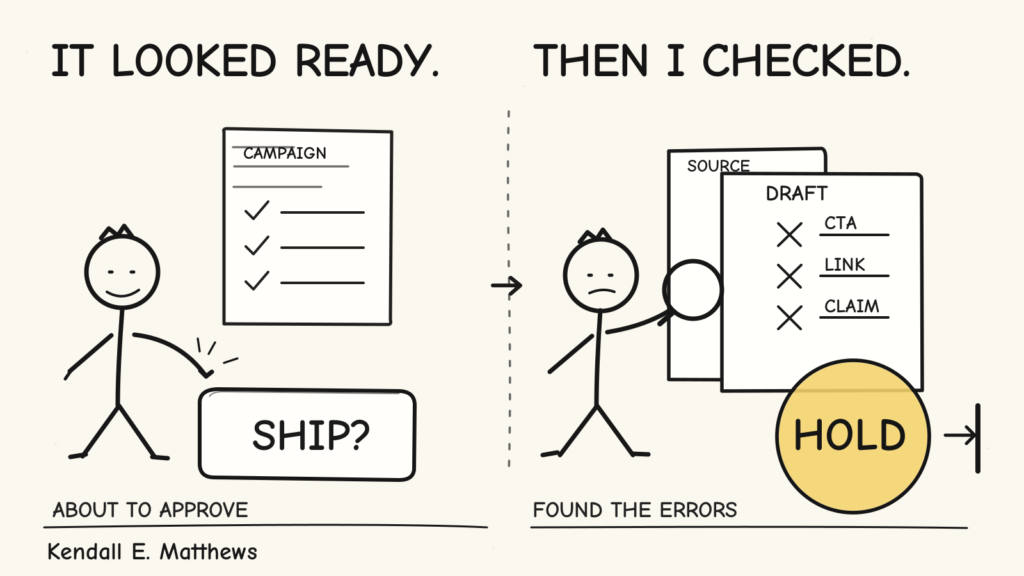
To be clear, this wasn’t a controlled test of Sabrina’s exact third prompt, and she did not create my audit. My recurring “What did you miss?” question and later source-checking work led there. Her video helped me think harder about challenging the question itself.
Then I caught the same mistake in my own story
While preparing the video about Sabrina, I found a line in my own script saying I’d tested her three prompts “for a year.” It sounded neat. Too neat.
I’d been using AI for roughly three years, and Sabrina’s video came in May 2025. But I hadn’t documented a precise twelve-month test of those exact prompts. I could not honestly put that number in front of viewers as a measured period.
This is how ChatGPT mistakes can sneak through: one sentence sounds real, and nobody stops to ask what proves it. So I removed the line. I also narrowed my criticism of her expert prompt after revisiting her example, and made clear that her “10x better” claim was her description, not my result.
There’s a related finding from a September 2026 experiment with 342 undergraduates. When ChatGPT offered incorrect advice, participants using ordinary ChatGPT support accepted that wrong advice in 62.4% of relevant trials. Those who had to answer reflection questions before deciding accepted it in 39.7%. The AI’s recommendations were similarly accurate across the two groups. The students changed how they judged the advice.
That’s research about short academic tasks, not proof of better marketing performance. What it gave me was a sharper question for my own work: What evidence would make me reject the answer, even when it sounds right?
The biggest correction in this article wasn’t something the AI got wrong about Sabrina. It was the standard I had to apply to myself.
Adapt it. Then execute.
My verdict on Sabrina Ramonov’s three prompts is ADAPT IT.
Ask for clarification when information is missing. Bring in another perspective when your own view may be too narrow. Challenge the premise before polishing the answer. And for work you’re about to publish or act on, compare it with the source instead of relying on AI confidence alone.
I added one more rule because there is another trap: you can improve prompts forever and finish nothing. I sometimes tell ChatGPT, “Improve this prompt twice, then execute.” Twice is a practical stopping point, because I do not accept first responses. If the source check finds a material problem, HOLD is still the right answer.
Here’s something you can try today.
Pick one real AI-assisted task: a marketing email, a proposal, a vendor recommendation, or a business idea. Give ChatGPT the task and the evidence it must follow. Ask what you missed. Then check the result against that evidence and decide what you’re actually prepared to approve.
You don’t need two years of trial and error to start doing that. And you don’t need AI to agree with you. You need a good enough answer to act on, and enough actual intelligence to know when it isn’t good enough.
RAMPUP: Copy and paste my versions of Sabrina’s 3 ChatGPT prompts
These are my expanded versions of Sabrina’s three ideas, not her exact wording. Start with one, apply it to a real task, and check the answer before you act.
CLARIFICATION
Ask me clarifying questions, one at a time, until you’re 95% confident you can complete the task successfully, and tell me how many questions you need to ask me.
TOP PERFORMER
What would a top 0.1% person in this field think, and provide your research and sources?
REFRAME
Reframe this in a way that challenges how I see the problem and explain it visually.
Remember: “95% confident” is a request in the prompt, not a measured confidence score. When ChatGPT cites research or sources, open them and check that they support the claims. That’s your second pass.