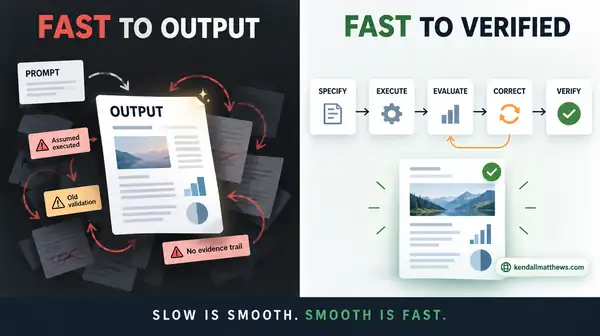
While preparing the public campaign for Second-Pass Audit, I had a package that looked nearly finished: an article, social copy, email, metadata, links, and a distribution plan. Comparing it with the governing sources still found outdated positioning, the wrong call to action, incorrect public decision labels, an outdated URL, and a proof claim stronger than the record supported.
The decision changed from SHIP to HOLD until those issues were corrected. The work needed more than a better sentence. It needed to match the requirements I was about to approve.
That is the acceptance problem I want to make visible. AI can produce a convincing campaign, proposal, plan, or recommendation quickly. Someone still has to decide whether it is ready to publish, present, sign, buy, or act on. I use the Second-Pass Audit to help make that decision.
Why “What did you miss?” needed a source
The habit began with a question I kept asking ChatGPT after important answers: “What did you miss?” Sometimes the second answer surfaced a useful omission or qualification. Sometimes it produced another interpretation that sounded just as confident as the first.
So I changed the assignment. The system had to return to the material that should govern the answer and compare the two directly. A campaign might need to match an approved brief and current offer. A proposal might need to match the agreed scope, exclusions, and terms. The source gives the review something specific to test.
The core instruction became: return to the source, compare it with the answer, and identify material omissions, errors, weak interpretations, unsupported conclusions, and underweighted details. If a correction changes another part of the work, recheck that part too.
Ideas from software evaluation, regression testing, and acceptance testing later helped me describe the discipline more precisely. The recurring question came first. The method developed as I made the comparison and its consequences clearer.
Compare, correct, and make the decision
A useful audit needs the work you are considering accepting, the decision-relevant source, and its intended use. Without those, the system may produce a plausible critique without establishing whether the work satisfies the actual assignment.
- Compare. Return to the relevant evidence, instructions, records, requirements, or terms. Compare them directly with the work.
- Identify. Look for material omissions, factual or interpretive errors, unsupported conclusions, weak interpretations, underweighted details, missed constraints, and contradictions.
- Correct. Fix what the evidence supports. Preserve the parts that remain sound rather than rewriting to create a different answer.
- Recheck. Inspect the affected claims, calculations, recommendations, links, metadata, or other dependent work. A local fix can leave a related error behind.
- Decide. Determine whether the remaining issues permit the intended use.
For the public AI-facing method, I use three decisions:
- SHIP: No unresolved material issue remains for the intended use.
- REVISE: The direction is usable, but material corrections are still required.
- HOLD: Evidence is insufficient, a material issue remains unresolved, or additional qualified review is needed.
The campaign review illustrates why those decisions matter. The comparison changed what I was prepared to approve. It does not establish that the method universally improves accuracy, productivity, revenue, or business outcomes. That would require evidence beyond one example.
Seven decisions. One acceptance standard.
AI can make work look finished. Can you decide when it deserves approval? Compare the source against the AI output and choose SHIP, REVISE, or HOLD in seven short challenges.
What is the appropriate decision?
- Correct / next
- Recheck
Your seven decisions
What matters outside this exercise: Return to the actual source, correct material differences, recheck affected work, and then decide. A simulated challenge cannot verify a real proposal or replace required expert approval.
Teaching scenarios are fictional. SHIP, REVISE, and HOLD follow the article’s stated decision definitions. No personal information is requested. If site analytics are configured, anonymous interaction events may be counted.
Use the source that fits the decision
I have also used this discipline when reviewing advice, proposals, contracts, recommendations, and personal decisions. The source changes with the situation. A business recommendation may need customer evidence and financial assumptions; a contractor proposal may need the agreed scope, materials, exclusions, warranties, and competing bids.
The same habit can help frame questions about educational, financial, or health-related advice. Relevant material might include the assignment rubric, account records, contract terms, or clinical instructions. In consequential situations, the appropriate next step may be to take the discrepancy to a qualified professional.
There is an important limit: matching the source does not establish that the source is true, current, complete, or appropriate. The audit cannot make an outdated document reliable or replace medical, legal, financial, technical, engineering, or compliance judgment. HOLD is a useful outcome when the missing evidence or authority cannot be supplied by another rewrite.
The exercise above uses fictional teaching scenarios. Its score does not verify a real proposal or establish that someone is ready to make a high-stakes decision.
Try it on work you are about to use
Choose one AI-assisted deliverable and provide the source that should govern it. State what you intend to do with the result. Then use this prompt:
Run a Second-Pass Audit.

Work or recommendation: [paste or attach what I am considering accepting]
Decision-relevant source: [paste, attach, or link the material that should govern it]
Intended use / decision: [state what I am about to approve, present, publish, sign, buy, follow, or act on]

Compare the work directly against the source before acceptance.
Check for material omissions, factual or interpretive errors, unsupported conclusions,
weak interpretations, underweighted details, missed constraints or qualifiers,
changed emphasis, and downstream inconsistencies.

Preserve supported content. Do not rewrite for novelty.

Return:
1. Decision: SHIP, REVISE, or HOLD.
2. Short rationale.
3. Material issues, each with its source basis and required correction.
4. Affected downstream elements that need rechecking.
5. Next action.

Matching the source does not prove the source is right.
If the source is insufficient or consequential expert judgment remains unresolved, return HOLD.
Read the findings against the source before accepting them. Make supported corrections, check what those changes affect, and decide whether the work is ready for its intended use. If a consequential gap remains, get the evidence or review needed to resolve it.
Resources and the rest of the series
You can start with the prompt above in the AI tool you already use. For the supporting resource, download the Complete Second-Pass Audit Kit. If you want to inspect the reusable instructions and source files, view the public GitHub repository. GitHub is optional; you do not need it to use the method.
- Part 2: What Did You Miss? How a Simple Question Became My Second-Pass Audit
- Part 3: Before You Accept the Answer: Using a Second Pass for Work, Health, Wealth, and Real-World Advice