
Loop: Outlearn. Outmarket. Outgrow, by HubSpot marketing leaders Kipp Bodnar and Kieran Flanagan, presents an AI-era marketing model built around four stages: Express, Tailor, Amplify, and Evolve. I tested the model against marketing work already in motion to determine whether it would materially change my AI marketing workflow or simply give me another system to manage.
The first thing I did after working through the book was decide not to build a Loop marketing operating system. That may sound like an odd way to open a positive review, but it is also the clearest evidence that I found the book useful.
A framework can create its own failure mode.
You find a useful idea, turn it into a new system, add a workflow around the system, create a scorecard to manage the workflow, and eventually spend more time maintaining the machinery than doing the work. I know that failure mode because I am naturally inclined to build systems, so I gave myself a constraint while reading Kipp Bodnar and Kieran Flanagan’s Loop marketing: nothing gets added because it sounds smart; it has to improve work that is already in motion.
That changed how I read the book.
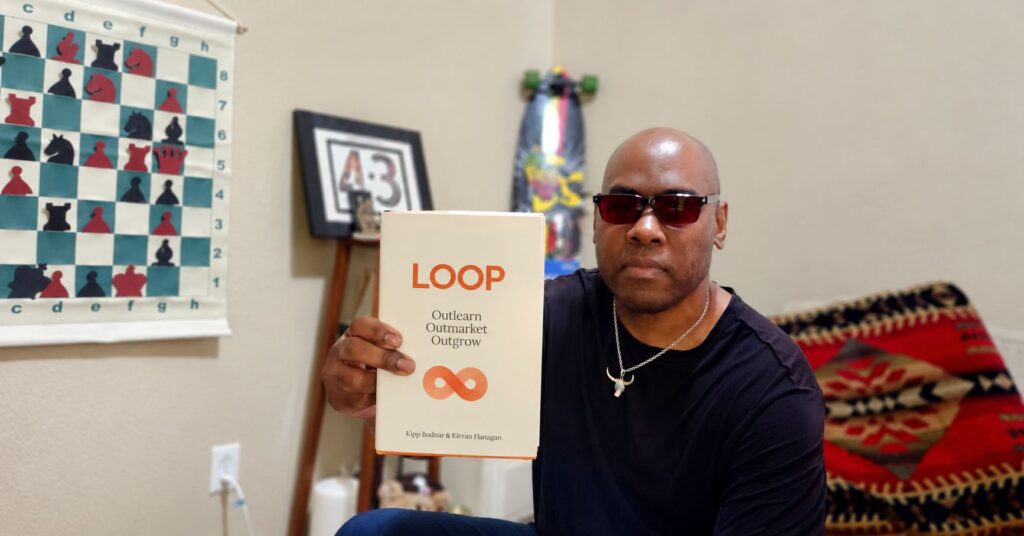
I did not treat it as a set of concepts to highlight. I used it against active work in AI-enabled marketing workflows, buyer simulation, content production, GTM strategy, operating-system design, YouTube, and LinkedIn. Underneath all of those projects was one larger question: When AI can execute more of the work, what should team members and I continue to own?
Several ideas earned a permanent place. Some validated things I was already doing, others are still experiments, and some did not justify another layer of process. That mix is what makes this a useful review rather than a summary.
What is Loop really asking marketers to change?
At its core, Loop marketing argues that adding generative AI tools to an old digital marketing process is not enough. The marketing workflow itself has to change.
One of the strongest arguments appears early, when the authors use the move from steam power to electricity to show why simply replacing an old technology with a new one can produce disappointing results. Factories did not realize the full advantage of electricity until they redesigned the floor around what the technology made possible.
That analogy maps cleanly to what I see happening with AI.
A busines can give team members an AI assistant and still keep the same briefs, handoffs, approval queues, production bottlenecks, reporting rituals, and quarterly learning cycles. The individual steps may get faster while the operating model stays old.
That leads to a question I now use more often: If this capability had always existed, would we design the work this way? If the answer is no, speeding up the old process is not enough. That is where Loop marketing became useful to me.
I was not starting from zero
The distinction between new, validated, and improved matters. Before reading the book, I already had an AI-based Buyer Simulator in use to pressure-test marketing from the buyer’s perspective. I was also building Think → Build → Prove to reduce unnecessary back-and-forth between strategy and execution, publishing across multiple channels, and using AI for research, content, analysis, and workflow design.
My broader operating philosophy was already Learn → Apply → Transform, so when the book introduced Buyer Sim, multichannel distribution, AI-assisted production, and faster learning cycles, my reaction was not “I have never seen this before.” The more useful question was whether those ideas made the system stronger. In several places, they did.
How did I apply Express, Tailor, Amplify, and Evolve?
I used the four Loop stages to shape a live business test and clarify the execution cycle I was already building.
- Express establishes who you are and who you serve.
- Tailor adapts the work to the person, format, and context.
- Amplify distributes it through the places where buyers actually spend time and make decisions.
- Evolve measures what happened and feeds the learning into the next cycle.
The terminology is less important to me than the closed loop. A lot of marketing teams are strong in only part of that system: some create constantly but underinvest in distribution, some distribute aggressively but learn very little from the response, and others collect dashboards full of metrics that never change a decision.
The Loop makes it harder to pretend those are separate problems.
The execution pattern I carried forward is approved anchor → produce → buyer check → publish → atomize → measure one consequential result → feed the evidence into the next cycle. The important shift is that the work is not finished when the asset ships. Shipping creates the next input, and that idea has already influenced how I am designing Think → Build → Prove 2.0.
The best integration decision was subtraction
This was the point where I could easily have made the work worse. I could have built a dedicated Loop marketing system beside Think → Build → Prove, then created rules for deciding which system to use, a router between the systems, and documentation for the router. That would have turned useful thinking into more operating overhead.
The better move was subtraction.
I went through the book’s prompts, workflows, and companion resources and ranked them against the work I actually need to do. Some earned immediate use, some are useful later, and some overlap with capabilities I already have. The Loop concepts that improved the existing operating system came in; the rest stayed out.
That is not a rejection of the book. It is the way I think a good framework should be used: a useful framework should improve the work, not become more work.
How does Buyer Sim differ from real customer research?
Buyer Sim is a pre-launch pressure test, not a replacement for real customer research or market evidence. The book’s concept immediately felt familiar because I already use an AI buyer simulation to test headlines, landing pages, emails, positioning, and other marketing before it reaches the market. Loop marketing did not introduce buyer simulation to me, but it did give the practice a clearer position in a larger system.
Buyer simulation is useful before launch because it can expose weak assumptions, unanswered questions, generic language, and likely friction without requiring every idea to go directly into market. The boundary matters, though: a simulated buyer is not a real buyer. The model can help me decide what deserves testing, but it cannot tell me what the market actually did.
That evidence only arrives after the work ships. The stronger cycle is context → create → pressure-test → ship → observe → learn → update, with buyer simulation inside the cycle rather than above it.
Should smaller teams adopt the Full Loop Marketer model?
Smaller teams should adapt the Full Loop Marketer model, not copy HubSpot’s implementation. The book argues that AI gives marketers the ability to own more of the lifecycle of their work instead of moving every stage through a different specialist. That does not make expertise irrelevant; it changes the economics of coordination.
Marketing organizations have accumulated enormous amounts of work that exist largely because work has to move between people: briefing, translating, assigning, waiting, reviewing, revising, reconciling feedback, chasing status, and rebuilding context at every handoff.
AI can make those handoffs faster, or it can remove some of them. Those are not the same outcome, and the latter is much more interesting.
That is one reason the book’s operating-model argument maps so well to Think → Build → Prove. You still own consequential judgment, AI can take on more of the mechanics, and specialists still matter when their expertise materially improves the result. Coordination should have to earn its place too.
I used the book to build a real test
I did not want my review to end with “interesting framework,” so I used the book to build an upcoming live session for service-business owners called “AI Broke the Marketing Playbook: What Business Owners Should Do Now.” The purpose is not to show a small business how HubSpot markets. It is to test what survives when the Loop meets smaller teams, fewer resources, less data, and a much lower tolerance for process.
That creates practical questions.
What does Express look like without an enterprise research function? How much Tailoring creates useful relevance before it becomes unnecessary complexity? Which Amplify channels deserve scarce time and money? What can a lean business realistically learn every 30 days, and which measurements matter because they change a decision rather than because a dashboard can display them?
I also created audience polling and supporting promotion around AI search, differentiation, lead generation, and measurement so the test is not happening entirely inside my own assumptions. The session has not happened yet, so there are no results to claim. Right now, the book has produced a better experiment, and the market still gets to grade it.
AI Broke the Marketing Playbook: What Business Owners Should Do Now
Live Friday, September 25
A practical test of what happens when HubSpot’s Loop Marketing approach meets the realities of smaller teams, limited resources, and AI-enabled execution.
Amplify forced a harder distribution question
The Amplify section arrived at the right time for another reason. For years, a large portion of digital marketing could treat Google as the default discovery engine. That environment is fragmenting as buyers discover ideas through YouTube, LinkedIn, newsletters, creators, communities, podcasts, and AI answers, often before they ever reach a company website.
I was already active across several of those channels, but the book pushed me toward a harder question: What audience do I actually own? That has led me to explore a more deliberate owned-audience strategy around KendallMatthews.com and the email infrastructure I already have instead of automatically creating another brand, newsletter, or platform.
That work is still exploratory, which matters. I count better decisions as an output of useful thinking, and sometimes the right result of reading a framework is deciding not to build something.
Measure Backward is the measurement idea I expect to keep
The book’s Measure Backward approach starts somewhere most dashboards do not: with the decision. What decision are you trying to make, what would you need to believe to make it confidently, and what evidence would strengthen or weaken those beliefs? Only then do you decide what to measure.
That sequence is deceptively useful because marketing has no shortage of numbers. What is scarce is evidence that changes a decision.
For my own Loop testing, I care less about whether the system produces more content than whether it helps me ship useful work faster, make the work more relevant to the intended audience, distribute it more deliberately, reduce unnecessary coordination, and learn something that changes the next decision.
Those are the outcomes that need evidence, and they are not proven yet.
What are the limits of the Loop marketing model?
The model’s breadth is both useful and risky. There is enough material in Loop marketing to create a lot of activity: prompts, frameworks, workflows, companion resources, measurement approaches, operating cadences, and AI use cases. It becomes a trap if the reader confuses comprehensiveness with an implementation checklist.
I would not implement everything, build a new system for every useful concept, or assume HubSpot’s implementation is the right implementation for a 20-person service company. HubSpot has data, distribution, tooling, talent, and experimentation capacity that a lean business does not.
The useful question for a smaller team is not “How do we reproduce HubSpot’s Loop?” It is “Which parts improve the constraint we actually have?” That is the test I am still running.
Who should read Loop: Outlearn. Outmarket. Outgrow.?
Loop is most useful for marketing leaders, founders, creators, and operators who already use AI tools and now need to redesign the work around them. If your main question is still “Should marketing use AI?”, this book may be several steps ahead of where you are.
The more interesting reader is already using AI and wrestling with how the workflow should change, what judgment should stay human, how to keep AI output from becoming generic, where simulated buyer feedback helps and where it stops, how distribution changes when search is no longer the only center of gravity, and which metrics actually inform decisions. That is the level where I found the book most useful.
My new test for a business book
I have a simpler standard after this exercise. A business book does not need to give me an entirely new worldview; it needs to earn a change.
Loop marketing changed a decision because I chose to integrate its strongest concepts into an existing operating system rather than create another one. It improved a workflow because distribution, buyer pressure-testing, consequential measurement, and regeneration now have clearer positions in the execution cycle I am building. It also produced a worthwhile experiment because I am testing a compressed version of the Loop against service-business realities.
That is enough for me to call the book useful.
This review is now part of the test
There is one final piece of evidence. I did not create five unrelated reviews of Loop. I created one evidence base that became an Amazon review, an Amazon video, a LinkedIn post, an Instagram version, and this article. The argument stays consistent while the expression changes by channel.
Now the market gets a vote through what people read, watch, respond to, and discuss. That response becomes evidence, and the evidence becomes input to the next cycle. That is more useful than ending a review with a star rating and moving on.
I did not just read Loop. I put it to work. Now the next cycle gets to tell me what was worth keeping.
Disclosure: I participated in the Loop marketing book ambassador launch group. This article reflects my independent assessment. The Amazon link below is an affiliate link. As an Amazon Associate I earn from qualifying purchases.


![How to Get Into Marketing – My True Story [video]](https://kendallmatthews.com/wp-content/uploads/2015/08/Kendall-Matthews-Ramp-Up-change-management-768x512.jpg)


