I had already identified one of my self-sabotage patterns: I can procrastinate with high-quality work.
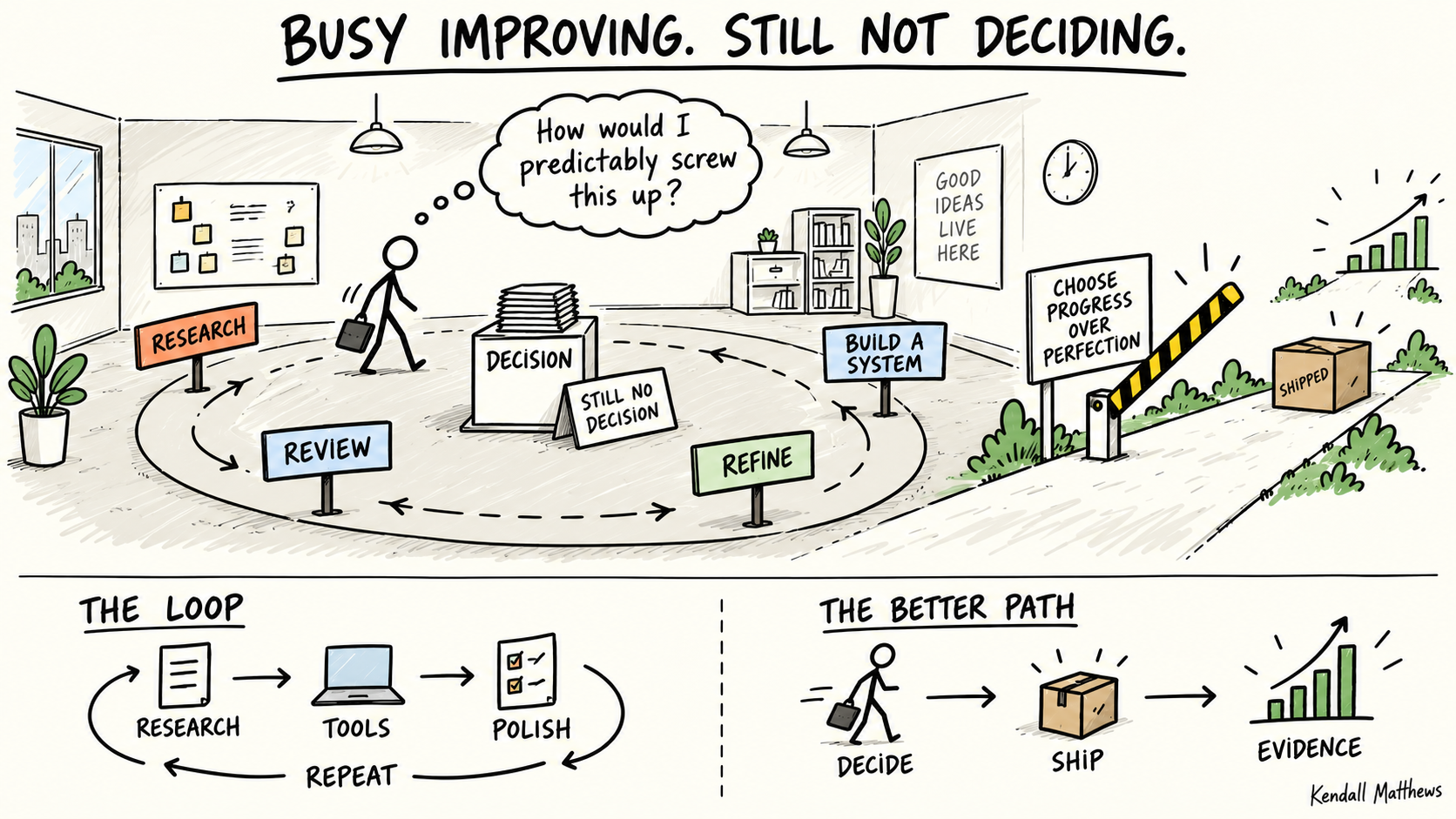
That sounds better than ordinary procrastination because the work is often useful. I may be researching, refining an idea, improving a framework, building a system, or examining another legitimate opportunity. Each activity can produce something valuable. But useful work can still be the wrong work when it delays the result that matters.
In my article Self-Sabotage for Smart People, I described how Charlie Munger’s idea of inversion helped me recognize these patterns. Rather than asking only what I should do to succeed, I began asking a less comfortable question: How would I predictably screw this up?
That question helped me identify the behaviors. It also left me with a problem I had not fully answered: How do I know whether those behaviors are actually changing?
One productive week is not enough evidence. Neither is one fast decision or one project shipped without excessive refinement. Those are encouraging examples, but they do not establish whether a recurring failure pattern has become less likely. Jared Tendler’s Inchworm Concept gave me a useful way to examine the difference.
Why self-sabotage in decision making can look responsible
I use self-sabotage in decision making to describe a recurring behavior that works against an outcome you say matters, even when you have enough knowledge or capability to act differently.
For capable professionals, the behavior often looks responsible. Another analysis may uncover a missed risk. An additional review may catch a costly mistake. A more detailed process may improve the quality of future work. Each action can be justified on its own.
The problem emerges when the behavior continues after its value has dropped. Research becomes a way to avoid making a supported decision. Refinement continues after the material risk has been addressed. Process expands until managing the process consumes more attention than completing the work.
That is what makes this form of self-sabotage difficult to recognize. The person is not necessarily avoiding effort. They may be producing sophisticated work that delays a more consequential action.
I have seen this distinction in my own work. My instinct is to connect strategy, technology, people, process, and evidence. When something works, I want to understand why and make it repeatable. That instinct has created real leverage, but it also creates opportunities to build more than a situation requires. Recognizing that tendency is a useful beginning. Changing the underlying behavior requires a different standard.
Your best performance and your reliable performance are different things
Jared Tendler’s Inchworm Concept describes performance as a range rather than a fixed level. He uses A-game for the strongest end of a person’s performance and C-game for the weakest. Most performance occurs somewhere between those extremes.
Tendler argues that improvement involves moving both ends of the range forward. Developing a stronger A-game increases what someone can do at their best. Improving the C-game raises the level they fall back to when performance deteriorates. I see this as a useful performance model, not a scientifically proven law. Its value for decision making is the distinction it makes visible.
Your best decision shows what you are capable of. Your worst repeatable decision behavior shows what you can currently rely on.
A leader can make an excellent high-stakes decision. A marketing team can run an unusually disciplined campaign, and a strategist can produce exceptional work under ideal conditions. Those accomplishments matter, but they tell us what happened in a particular situation.
The more revealing test often comes when deadlines compress, information is incomplete, priorities compete, or a new opportunity draws attention away from existing commitments. Does the same judgment hold under those conditions?
That question changes how I think about progress. An exceptional result demonstrates capacity. More reliable behavior demonstrates that some of that capacity is becoming part of ordinary performance.
Why more knowledge does not always produce better decisions
I have spent years improving my ability to add useful capabilities. Knowledge, technology, marketing methods, research, AI tools, workflows, and operating systems have all expanded what I can accomplish.
I still consider learning an advantage. The weakness appears when acquiring another capability becomes easier than applying the capabilities already available.
For example, AI makes it possible to generate several strategic alternatives in minutes. I can request more research, additional evaluation criteria, another workflow, or one more revision at relatively little cost. Sometimes those additions materially improve the decision. Other times, they create sophisticated work that does not change what should happen next.
The danger is that my strongest capabilities can continue developing while an old failure pattern remains. I can become better at research without becoming better at stopping research. I can become better at designing systems without becoming more disciplined about deciding which systems deserve to exist.
This distinction fits the progression I use for my own development: Learn → Apply → Transform. Learning expands what I understand. Application tests whether that knowledge improves real decisions and work. Transformation becomes visible when the improved behavior holds up under conditions that previously caused the old pattern to return.
Knowledge can move faster than behavior. That is why another insight, course, tool, or framework may increase capability without producing the change that matters.
The difference between raising the ceiling and raising the floor
Consider two possible directions for improvement.
In the first, I keep raising the ceiling. My research becomes stronger, my AI tools become more capable, and my frameworks become more sophisticated. Under favorable conditions, I can produce excellent work. But when priorities compete or uncertainty appears, I still open unnecessary research paths, keep too many opportunities active, or refine work after the important risks have already been handled.
The ceiling moves higher while the floor changes very little.
In the second direction, peak performance may improve at a slower pace, but the weaker behaviors begin losing their influence. I recognize unnecessary refinement earlier. I become less likely to build infrastructure before repeated experience justifies it. When an attractive new opportunity appears, I have a stronger basis for deciding whether it deserves attention now.
This is not as exciting as another breakthrough. It may, however, produce more dependable work. The distinction is especially important in leadership because outcomes depend on decisions made across ordinary working conditions. A team cannot rely on its leader having an exceptional day whenever priorities conflict or a consequential choice needs to be made.
The goal is not to eliminate every weak decision. It is to reduce the frequency, severity, and lasting cost of predictable mistakes.
How inversion helps identify the behaviors holding the floor down
Tendler’s Inchworm Concept and Munger’s inversion approach serve different purposes in my thinking. Tendler’s model helps me examine the gap between stronger and weaker performance. Inversion helps me investigate the behaviors that repeatedly pull performance toward the weaker end.
The question becomes: If I know what good judgment looks like, what am I still doing that makes it harder to practice consistently?
Two patterns stand out in my work. The first is over-refinement. Quality matters, particularly when a decision affects a customer’s trust, a company’s reputation, or a material business outcome. But another revision is not automatically valuable. Once the important risk has been addressed, continuing to polish may improve the artifact slightly while delaying the result substantially.
The second is unnecessary system-building. I naturally want useful work to become repeatable, but repetition should normally provide evidence that a system is needed. Building a complete process for a task that has not yet proved its value can become a way to avoid the uncertainty of doing the work.
These patterns do not mean research, refinement, or systems are bad. They mean each needs to justify its cost against the decision and outcome it is supposed to improve. This is closely related to a distinction I explored in The Decision Making Trap That Looks Like Good Leadership: some controls protect the business, while others become artificial prerequisites that protect delay.
The leadership challenge is knowing the difference.
Don’t eliminate bad days. Make them less expensive.
A realistic approach to improving weak performance does not require perfection. It requires paying attention to what happens when an old pattern returns.
I would examine three practical measures. Frequency tells me whether the behavior is appearing less often. Severity tells me whether it causes less damage when it appears. Recovery tells me how quickly I recognize the problem and return to useful work.
A recurring pattern might initially consume most of a working day before it is recognized. Later, the same pattern might be identified within an hour. That would not mean the behavior had disappeared, but it would represent a meaningful reduction in its cost.
One research-backed technique that can help people act on their intentions is the implementation intention. Instead of making only a general commitment, a person identifies a recognizable situation and the response they intend to take.
Psychologists Peter Gollwitzer and Paschal Sheeran examined this approach in a 2006 meta-analysis covering 94 independent tests. They reported a medium-to-large positive effect on goal attainment. The finding supports the usefulness of planning responses to predictable conditions. It does not validate Tendler’s entire Inchworm model.
The practical application can be simple. If another revision will not change a supported decision or address a meaningful risk, I should stop refining and move the work forward. If additional research will not change the next action, the next action deserves priority.
A guardrail is useful only when it remains practical under the conditions that usually trigger the problem. If the solution requires another elaborate system that I will not follow on a difficult day, it may reproduce the very behavior I am trying to change.
AI makes this a more important leadership problem
AI has expanded what I can produce, and that changes the consequences of poor decision habits. Research, strategy development, writing, analysis, and process design can now move much faster. Work that once required considerable time can be generated, revised, and compared in a fraction of that time.
That creates substantial opportunity when the additional output helps someone make a better decision or produce a better result. It also lowers the cost of creating material that adds little value.
A 40-page strategy can look impressive even when a short test would provide better evidence. A detailed evaluation framework can seem responsible even when the decision criteria are already clear. Another round of revisions can make the work more polished without making it more useful.
In each case, the problem is less about production capability than the judgment used to decide what deserves to be produced.
A leader who can use AI well but cannot stop unnecessary work may simply create higher-quality waste faster.
That is one reason I have become more interested in controlling the work around AI than simply increasing the amount of work AI can generate.
In my approach to AI-enabled execution, I use Think → Build → Prove to distinguish responsible reasoning, actual production, and verification. The objective is to apply enough structure to produce dependable work without allowing the structure itself to become the obstacle.
The same thinking also informs my Second-Pass Audit. Generating a polished answer does not establish that it deserves acceptance. A return to the source helps determine whether the work is supported.
Both examples point toward the same executive responsibility: understanding which controls protect an outcome and which activities merely make the process look sophisticated.
How I would raise my decision-making floor
I would begin with one decision area rather than trying to improve every part of my performance at once.
First, I would describe what strong execution actually looks like. That gives me a useful reference point. Then I would name the recurring behavior that most often pulls the result backward, using an observable action rather than a broad personality judgment.
Next, I would examine when that behavior tends to appear. Is it triggered by uncertainty, a looming deadline, competing priorities, or the availability of another attractive idea? The answer matters because a guardrail is more useful when it addresses a recognizable condition.
I would then choose the smallest response that could interrupt the pattern without introducing more unnecessary work. For refinement, that might mean using a clear decision about whether another revision can still change the outcome. For research, it might mean returning to the next executable action once the evidence is sufficient.
Finally, I would look for evidence over time. Is the behavior less frequent? Does it cause less damage? Am I recognizing it earlier? I would not expect one successful week to prove permanent change. The point is to establish whether the direction of behavior is improving, particularly when conditions are less favorable.
What transformation means to me now
For years, learning more created enormous leverage for me. I expect it to remain valuable, especially as technology changes the work leaders are capable of doing. But I no longer want to treat learning more as sufficient evidence of progress.
The more useful test is whether knowledge changes a decision, improves work already in motion, removes a predictable failure, or becomes a dependable capability.
That is what connects this idea to Learn → Apply → Transform. Learning makes better performance possible. Application tests the idea against real conditions. Transformation becomes visible when improved judgment is no longer dependent on having an exceptional day.
Your best day tells you what is possible. Your floor tells you what is becoming normal.
If a self-sabotaging behavior still regularly defeats the outcome, there is more work to do. If the pattern becomes less frequent, less damaging, and easier to recover from, the change is becoming more dependable. That is the kind of progress I want to measure.
Frequently asked questions
What is self-sabotage in decision making?
In this article, self-sabotage in decision making means a recurring behavior that works against an intended outcome, even when a person has the knowledge or capability to act differently. For capable professionals, it may appear as unnecessary analysis, excessive refinement, too many active priorities, or process that continues after its value has dropped.
Why do capable people repeat poor decision patterns?
Knowledge and capability do not automatically change habitual behavior. Someone can become more skilled while continuing to respond to pressure, uncertainty, or competing priorities in familiar ways. Recognizing a pattern is useful, but improvement also requires changing the response and observing whether the behavior becomes more reliable.
What is Jared Tendler’s Inchworm Concept?
Jared Tendler’s Inchworm Concept describes performance as a range between a person’s strongest performance, or A-game, and weakest performance, or C-game. The model emphasizes improving both ends of that range rather than focusing only on new peaks.
How can leaders reduce self-sabotaging decisions?
Leaders can begin by naming a recurring failure pattern, identifying the conditions that trigger it, and establishing a practical response. Progress can then be examined through changes in how often the behavior occurs, how much damage it causes, and how quickly the person or team recovers.
What does raising your performance floor mean?
Raising your performance floor means improving the weaker end of your normal performance range. The objective is more dependable behavior across ordinary and difficult conditions, rather than relying primarily on occasional exceptional performance.
Continue reading
In The Decision Making Trap That Looks Like Good Leadership, I examine how responsible-looking processes can become unnecessary barriers to execution.
For the failure-prevention side of this discussion, read Self-Sabotage for Smart People: The Charlie Munger Question That Exposes Your Failure Patterns.
Sources and further reading
- Jared Tendler, The Inchworm Concept
- Peter M. Gollwitzer and Paschal Sheeran, Implementation Intentions and Goal Achievement: A Meta-analysis of Effects and Processes (2006)
- Berkshire Hathaway, 2009 Shareholder Letter, including discussion of Charlie Munger’s inversion approach