I was using AI to get work off my plate. Somehow, I was still the project manager, quality inspector, and person reminding it to finish. That got old.
The AI could research a problem, recommend a solution, and produce something useful. Then I’d discover that the remaining steps were waiting for me: verify the result, correct an issue, or get the work into production. I hadn’t really delegated the outcome. I’d delegated a task.
Reading Felix Rieseberg’s essay on being more ambitious with AI helped sharpen the distinction. He calls it altitude: asking for the outcome beyond the immediate task. My question was how to carry that idea into actual projects while keeping the decisions that require my judgment.
A dashboard exposed the difference
I built an AI-assisted dashboard to track opportunities and deadlines. It looked good. It also displayed some deadlines incorrectly because of a time-zone conversion problem. That’s the kind of error that can cost you an opportunity while the dashboard confidently tells you everything is fine. At that stage, we’d identified the cause, but the correction had not yet been deployed and tested.
Asking AI to fix the dashboard can produce code and a confident explanation. Asking it to work toward a reliable dashboard means identifying the defect, correcting it, testing the relevant date cases, deploying when authorized, and reporting what actually passed. Until those checks were completed, the original tracker deadlines were the safer reference.
That experience gave me a practical standard: a proposed fix, a deployed fix, and a verified result are three different things.
Key Takeaways
- Delegate the outcome, not just the task, or you may remain the project manager.
- Define authorized actions, approval boundaries, and what a verified finish requires.
- A proposed fix, a deployed fix, and a verified result are different things.
Why I changed the assignment
I’d already been developing Think → Build → Prove: decide what matters, make the thing, then confirm it works. I also preferred using Chat when it had the necessary tools rather than creating a handoff just to create one.
On October 21, I approved a reusable instruction to push AI beyond the first deliverable. It should handle the intermediate work it has permission to perform and bring decisions back to me when they actually require my judgment.
The AI project instruction
Here’s the wording I use alongside the specific outcome, source material, and approval boundaries:
Work toward the outcome, not merely the immediate task.
Determine the strongest approach using available evidence, professional techniques, relevant tools, and current project decisions.
Carry out all authorized intermediate work without requiring me to manage each step.
Preserve approved decisions unless new evidence or a material flaw warrants reconsideration.
Verify consequential claims independently. Correct material errors and complete downstream work.
Distinguish what was decided, produced, deployed, and verified. Surface only decisions requiring my judgment, genuine blockers, or material risks.
Do not create additional frameworks, documentation, or workflows unless they materially improve the result.
The line that matters most to me is: “Carry out all authorized intermediate work without requiring me to manage each step.” The word authorized matters. Delegating execution doesn’t hand over the decision to publish, spend money, or accept an unverified result.
Give AI a finish line it can check
Try this on a project you can finish and verify. Tell AI what you want delivered, which sources and tools it can use, and which actions require approval. Then add the instruction above.
Here is what the change looks like:
- Instead of: “Fix my dashboard’s deadline calculations.” Try: “Correct the deadline calculations, test the time-zone edge cases, and verify the deployed dashboard when authorized. Report any failures that remain.”
- Instead of: “Write a blog article.” Try: “Write for this audience, check the claims, prepare the WordPress draft, and show me the preview before publishing.”
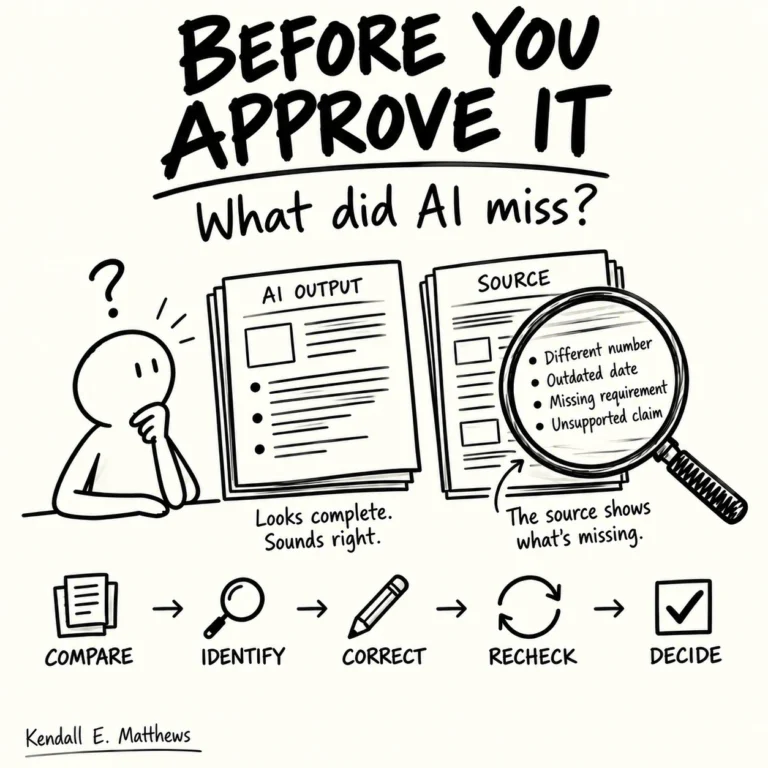
When AI reports completion, ask two separate questions: Did it finish the work? And does the evidence show the work meets the standard? For source-sensitive work, I use a Second-Pass Audit to compare the output with its original requirements. I’ve also written about the decision-making trap that looks like good leadership.
Try it with a task you already have on your list. Compare what AI delivers with what you asked it to finish. Which steps were completed, and which ones came back to you?
My role is still to decide what matters and judge the result. AI can own the intermediate steps it’s authorized to take. If the outcome hasn’t been checked, “done” is still a claim.